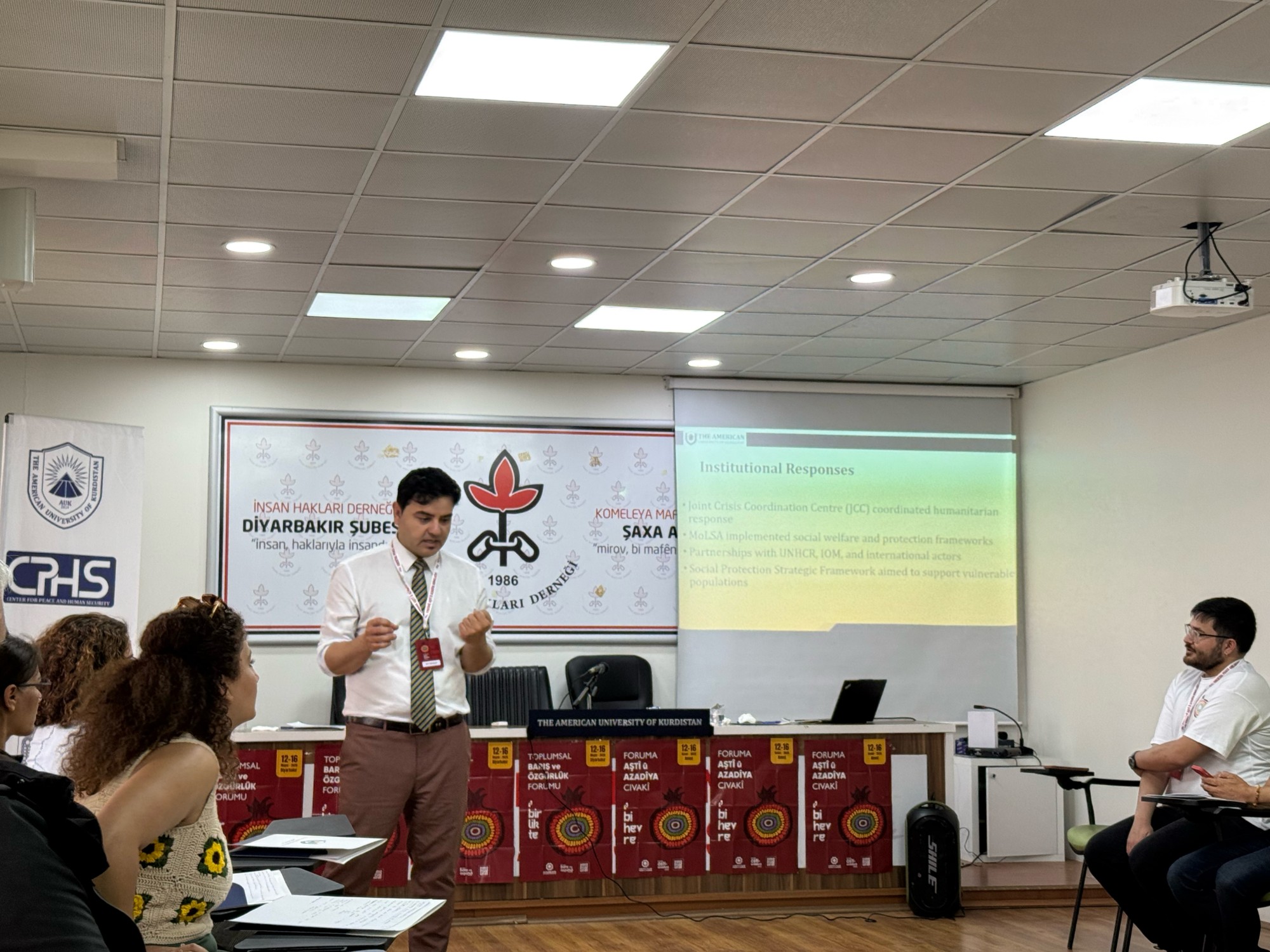
In partnership with Diyarbakir Metropolitan Municipality, the American University of Kurdistan’s Center for Peace and Human Security (CPHS) organized a workshop at the Societal Peace and Freedom Forum in Diyarbakir focused on internally displaced persons (IDPs) in the Kurdistan Region of Iraq.
The event was attended by the Co-Mayors of Diyarbakir Metropolitan Municipality Serra Bucak and Dogan Hatun, alongside policymakers and public officials from across Turkey and the Kurdistan Region. The workshop also hosted the Governor of Duhok, Ali Tatar, and the Governor of Erbil, Omed Xoshnaw, both of whom emphasized the Kurdistan Region’s longstanding commitment to hosting refugees and IDPs regardless of religious or ethnic background. They highlighted the Kurdistan Region’s experience as a model of coexistence, humanitarian responsibility, and resilience in times of local crises.
The event brought together students, academics, civil society actors, and policymakers to engage in critical dialogue on issues across the Kurdistan Region and the wider Middle East.
The workshop, titled “From Displacement to Coexistence: Justice, Return, and Social Cohesion in the Kurdistan Region,” explored the complex relationship between displacement governance, human security, peacebuilding, and the future of coexistence in conflict-affected societies.
“The Kurdistan Region is not only a place from which millions have been displaced since the mid-20th century; it has also hosted millions of refugees and IDPs, particularly since the emergence of ISIS and successive crises in neighboring countries,” said Jiyar Aghapouri, Associate Professor and Director of the CPHS.
“Considering its limited resources, internal challenges, and the fact that the Kurdistan Region is not a sovereign state with direct access to major humanitarian funding mechanisms, what the Kurdistan Regional Government has achieved in managing displacement is remarkable,” Aghapouri noted. “Part of this achievement can be traced to the Kurds’ own lived experiences of displacement, trauma and persecution. This experience has shaped not only institutional practices, but also the ways social cohesion is negotiated at the community level, rather than through abstract models of peacebuilding.”
A seasoned reporter and analyst who specializes in Kurdish affairs.