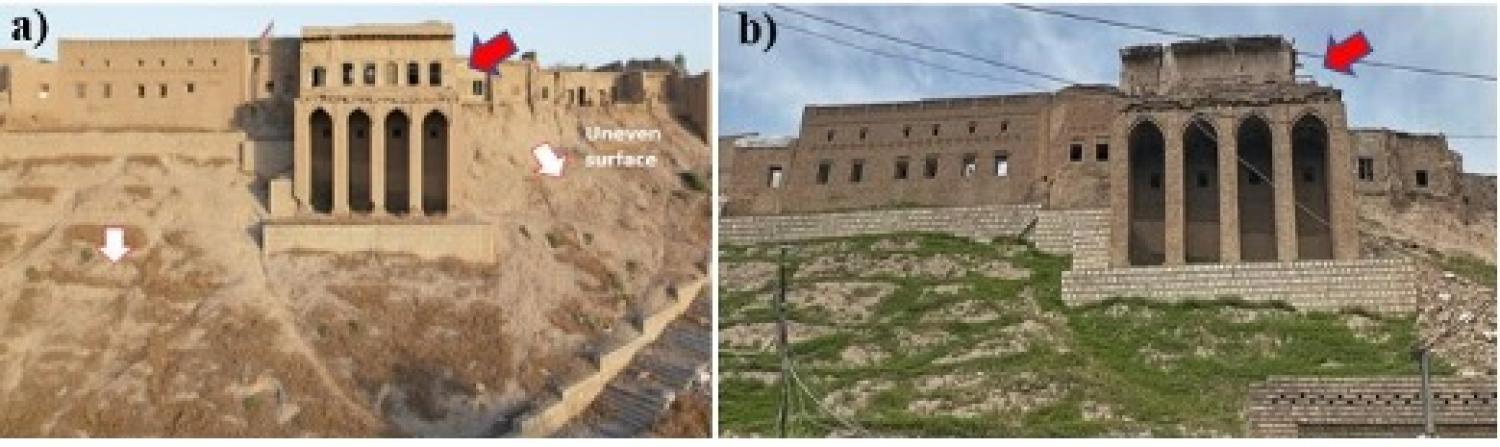
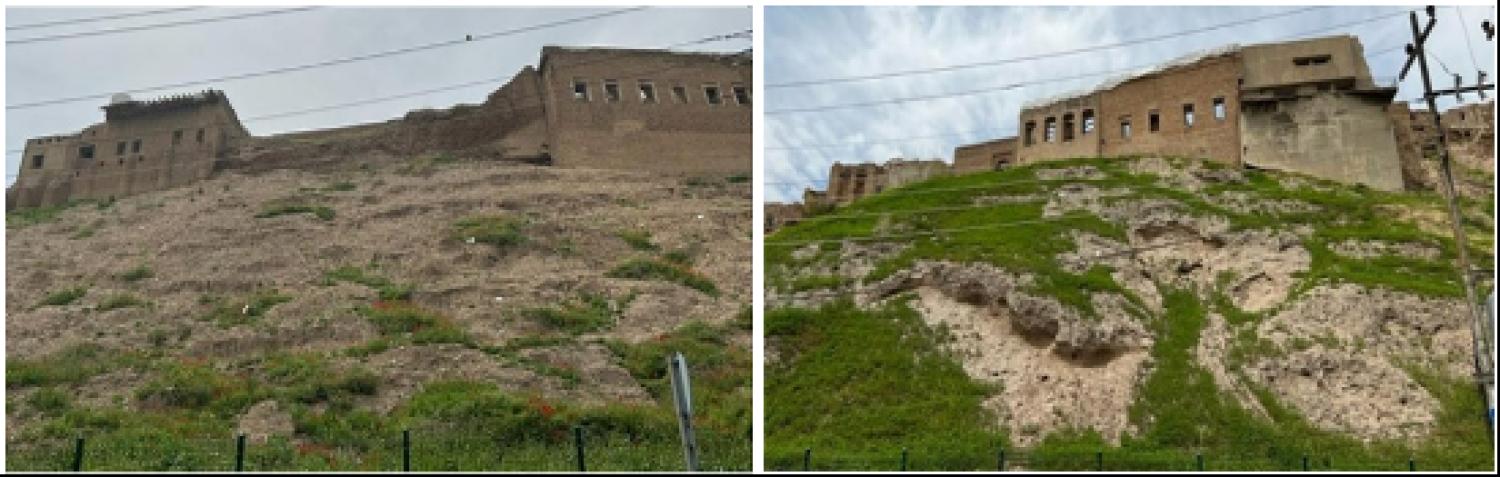
In April 2023, photographs of the old palace of Ali Pasha — perched on the upper edge of the Erbil Citadel — captured the destructive consequences of neglect. The uppermost section of the structure had collapsed, taking with it a piece of the city’s architectural memory. The cause was not war or weather, but the slow physics of an unstable slope.
The old palace of Ali Pasha, before and after its collapse, photographed April 19, 2023
For a place that has stood for 6,000 years, this kind of erosion is the most consistent threat the Citadel has faced. And it is not isolated. Cracks now run along the slopes themselves and through some of the perimeter houses that ring the mound. Without intervention, more of the Citadel will follow the fate of Ali Pasha’s roof.
A Mound Shaped by Millennia
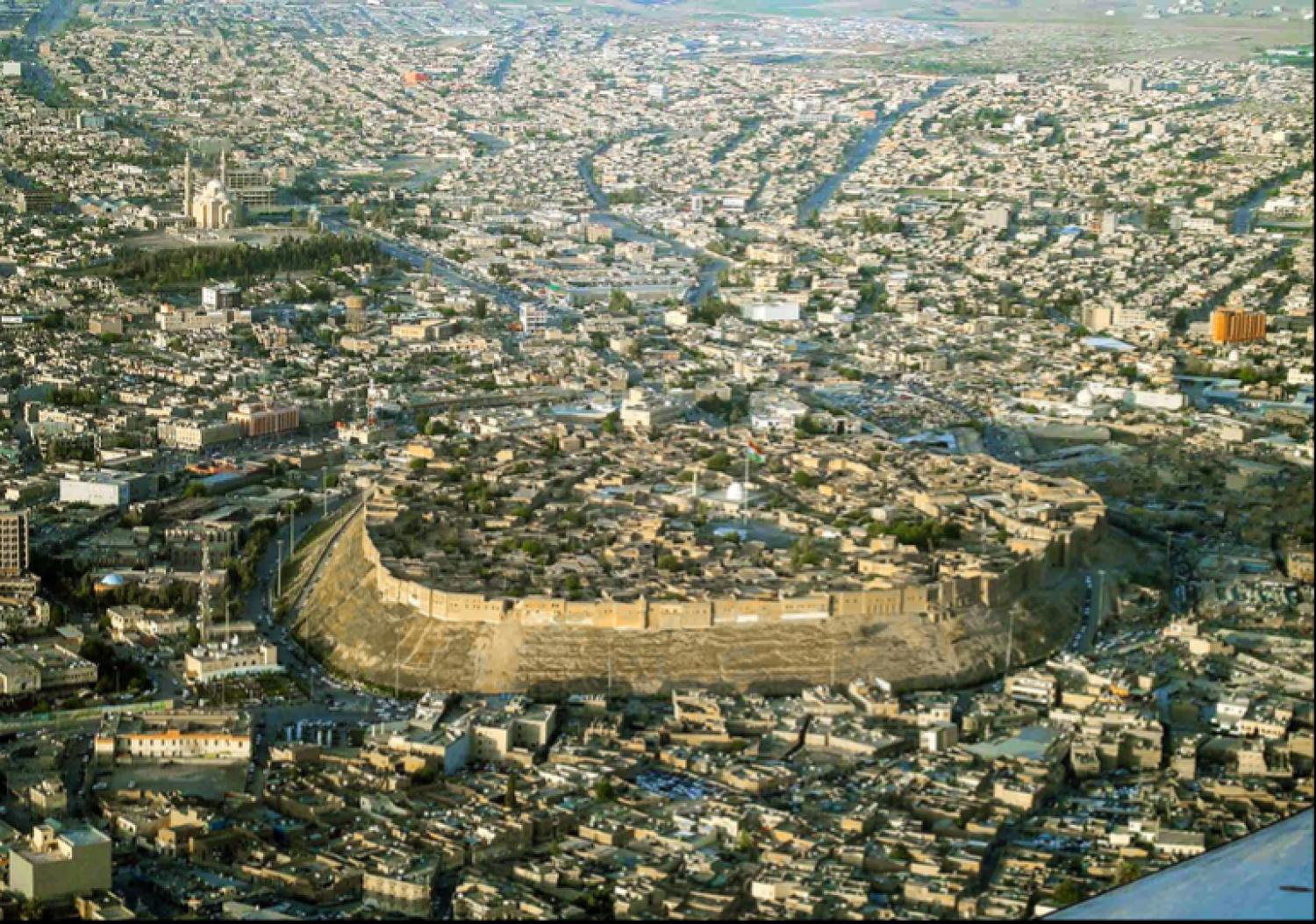
The Erbil Citadel rises 28–30 meters above the surrounding plain, an oval-shaped tell that has grown over thousands of years as one settlement was built on top of another. Today it sits at the center of the modern city of Erbil, the capital of the Kurdistan Region of Iraq, with the contemporary urban fabric spreading outward around it.
Erbil Citadel rising above the modern city that has grown around it
Archaeological findings reveal layer upon layer of previous habitation. The Citadel was built mainly of mud mixed with hay; in places, pieces of old brick are visible within its slopes. The mud was sourced from the surrounding plains and consists of clay and gravel.
The Citadel’s highest point — at the center — sits at 429 meters above sea level. The lowest points around its perimeter range from 407–416 meters. Its oval form measures roughly 0.35 km north–south and 0.42 km east–west, with diagonal axes of similar length.
A Name Carried Through Millennia
Erbil’s name has remained remarkably consistent through history, with recognizable versions — from Irbilum, Urbilum, Urbel, Arbail, Arbira, and Arbela to Erbil or Arbil — appearing in written sources as far back as Sumerian times. Settled more than 6,000 years ago, the Citadel is believed to be one of the longest continuously inhabited sites in the world. The earliest evidence of habitation on the Citadel mound dates to the 5th millennium BCE. In the Neo-Assyrian period, the Citadel was an important center, especially under the reign of King Ashurbanipal (669-631 BCE).
In 331 BCE, Alexander the Great defeated the Persian king Darius III on the plains surrounding Erbil at the Battle of Gaugamela, one of the most famous engagements of antiquity. In the medieval period, the city was home to famous poets, historians, and scholars, and it later served as a cultural and administrative center under the Ottoman Empire.
The original fortifications were, over time, replaced by houses. The continuous wall of 19th-century house facades still conveys the visual impression of an impregnable fortress dominating the city. The artificial topography of the archaeological mound has shaped the settlement’s layout; the Ottoman-period urban fabric remains clearly legible in the maze of alleys and cul-de-sacs radiating from the main Grand Gate.
During the 20th century, however, the Citadel’s existing buildings were heavily modified or destroyed. The site has been uninhabited since 2006 and is undergoing reconstruction. Most of the remaining structures date from the 19th and 20th centuries. The oldest surviving building is the hammam, which dates to 1775. The perimeter wall is not a continuous fortification but the facades of approximately 100 houses built against each other.
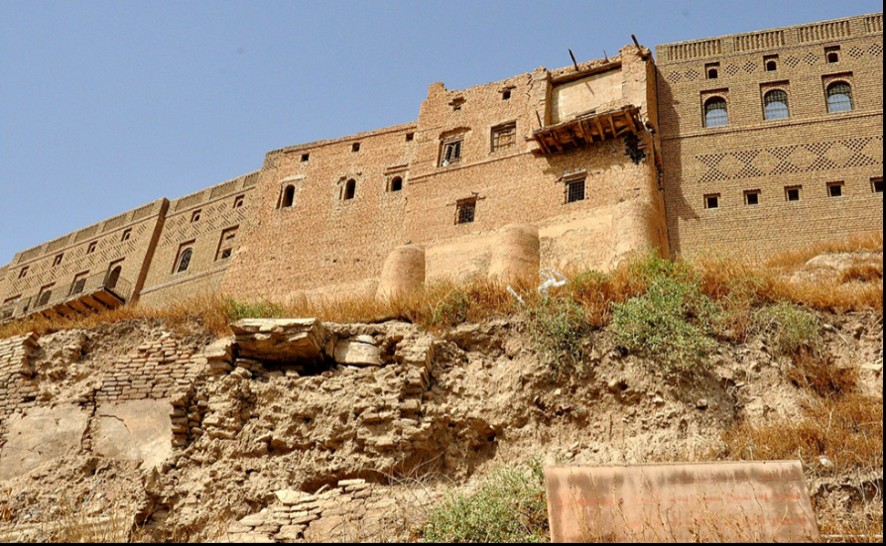
A side view of the Erbil Citadel, showing the accumulated remains of different generations
The first systematic archaeological excavations at the Citadel began in 2013, and on June 21, 2014, the site was inscribed as a UNESCO World Heritage Site. The Citadel is now open to the public and is a popular destination for visitors from across Iraq and abroad.
In 2007, the High Commission for Erbil Citadel Revitalization (HCECR) was established to oversee its restoration. The HCECR is working with UNESCO to conserve and rehabilitate the Citadel through its Conservation and Rehabilitation Master Plan. The Kurdistan Regional Government plans to settle 50 families inside the Citadel once the work is complete.
Restored Above, Eroding Below
The restoration program has been substantial. Many important buildings have already been restored, and more are planned. But far less attention has been paid to the slopes supporting it.
This is increasingly urgent. Cracks already visible on the slopes and in some of the perimeter houses point to active instability. If the slopes are not assessed and systematically reinforced, they will continue to erode — taking with them the houses sitting on the periphery.
The Ali Pasha collapse is the clearest illustration of what slope erosion looks like in practice. Other indications of instability are visible across the perimeter.
Uneven slopes along the Citadel perimeter signal active instability
What the Citadel Means
For the people of Erbil — and for visitors who walk through the city beneath it — the Citadel is more than an archeological site. For millennia, it has inspired artists, poets, and the ordinary residents who pass beneath it every day. To lose more of it to the slow collapse of houses on the periphery would represent both a degradation of the site and a serious loss to its historical value, even as UNESCO-led restoration continues elsewhere on the mound.
What Can Be Done?
Before any specialized team can conduct a full scientific assessment, several immediate steps could meaningfully reduce the risk of erosion:
· Construct a rainwater drain along the uppermost edge of the slopes to reduce water flow down the Citadel face.
· Remove fallen blocks of old retaining walls wherever they are found on the slopes.
· Ban any further weight on the slopes — no new retaining walls or other construction.
· Install motion sensors to detect movement around the slopes.
· Establish fixed monitoring points with surveyed coordinates tracked via GPS.
For a place that has stood for 6,000 years, the threat now is neither war nor weather, but slow erosion driven by mud and water. Saving the Citadel will mean reading those slopes as carefully as the archaeologists have read its layers.
Senior Researcher, Komar University of Science and Technology / Professor, Cihan University-Erbil