Why domestic electricity – not exports – should be Erbil’s priority
In May 2025, the Kurdistan Region secured a significant geopolitical win during KRG Prime Minister Masrour Barzani’s visit to Washington, D.C., where he oversaw the signing of agreements with U.S. companies that could mobilize up to $110 billion in long-term investment if fully implemented. The deals center on developing roughly 8 trillion cubic feet (tcf) of gas at the Miran field and about 5 tcf of gas – plus nearly one billion barrels of oil – at the Topkhana–Kurdamir blocks, with major new volumes expected from mid-to-late 2026, building on the already-completed KM250 expansion at Khor Mor that began producing in late 2025.
If fully implemented, these projects would significantly expand the Kurdistan Region’s gas production capacity to around 1 billion cubic feet per day over the second half of the decade, with somewhat lower volumes likely to reach the grid after processing and reinjection.
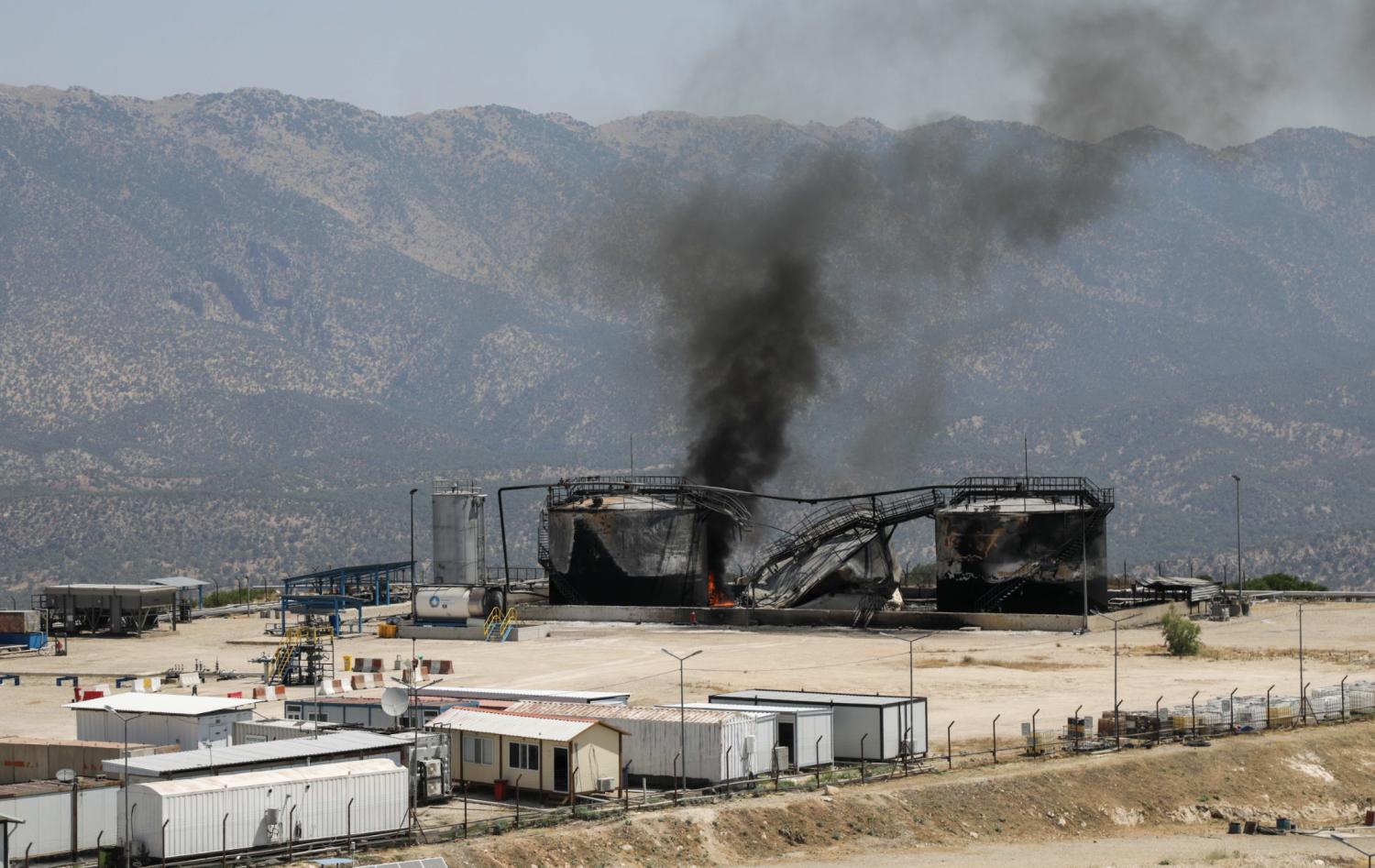
However, that momentum was disrupted late last year, when the Khor Mor field was struck by drones in November, prompting a temporary shutdown of the field. Kurdish and Iraqi officials attributed the attack to Iran-aligned militia groups. The strike was not an isolated incident: the Kurdistan Region’s energy infrastructure came under repeated drone attacks in June and July, and the November assault marked roughly the 11th reported attack on Khor Mor since 2022. Compounding the security challenge, Baghdad has questioned the legality of the energy contracts signed in May, declaring them “null and void,” underscoring the persistent political and legal tensions between Erbil and the federal government over control of hydrocarbon resources.
The November attack fits a broader pattern in which energy infrastructure has become a coercive instrument to limit Erbil’s fiscal and energy autonomy and preserve Iran’s role as Iraq’s external gas supplier. At the same time, sustained U.S. political and commercial backing signals an intent to bolster the region’s energy capacity at Iran’s expense. While the long-term objective of achieving a gas surplus remains strategically attractive, it simultaneously creates new vulnerabilities that Erbil will need to manage alongside its economic and geopolitical gains.
This piece argues that while the Kurdistan Region’s prospective gas surplus is strategically valuable primarily for domestic power security and intra-Iraqi cooperation, its emergence simultaneously heightens geopolitical risk, especially from Iran, while offering only limited relevance to global gas markets and minimal leverage in European energy security debates.
U.S. energy diplomacy
The geopolitics of the Middle East have shifted in recent years. The fall of Bashar al-Assad reshaped the Levant, while the post-October 2023 confrontation between Israel and Iran-aligned actors has altered regional power dynamics – including in energy. Across the region, U.S. energy diplomacy has become more visible, from expanded liquified natural gas (LNG) sales to Turkey to renewed involvement in Iraqi oil fields and emerging electricity links between Israel and Egypt. For the Kurdistan Region, this broader pattern matters more than any single contract. During U.S. President Donald Trump’s Gulf tour in May, he pushed regional states to purchase more U.S. LNG, underscoring Washington’s broader export strategy.
Gas production from Khor Mor’s KM250 expansion began in late 2025 and has been ramping up through 2026, subject to security conditions. This presents an opportune time within a U.S. foreign policy framework that aims to reduce Baghdad’s dependence on Iranian gas, create commercial opportunities for U.S. firms, and diversify regional supply in ways that indirectly constrain both Russia and Iran.
Russia and Iran
Russia’s invasion of Ukraine in 2022 reshaped global gas trade flows, accelerated diversification strategies, and intensified competition among current and prospective suppliers across Eurasia and the Middle East. Moscow has tried to pivot gas exports toward China, but progress has been slow and commercially constrained, leaving Russia with fewer easy alternatives to European markets.
Against this backdrop, competition with Russia now extends to a broader set of Eurasian producers, among which the Kurdistan Region is emerging as a potentially meaningful entrant. Estimates of the Kurdistan Region’s gas endowment vary widely: KRG officials cite up to 200 tcf of potential resources; the U.S. Energy Information Administration places Iraq’s total proven reserves at 131 tcf; and independent analysts suggest the Kurdistan Region’s economically recoverable share may be closer to 25 tcf, or roughly 20% of Iraq’s total. While this wide divergence underscores the uncertainty surrounding reserve estimates, it does not diminish the strategic significance of the Kurdistan Region’s gas endowment, which is substantial by regional and global standards.
Countries tend to face their greatest geopolitical risk in the energy domain when they appear to be on the verge of threatening the market shares of entrenched producers. History shows that rising energy powers often trigger geopolitical pushback. During the 1990-1991 Gulf War, for example, Iraq’s potential control over Gulf oil supplies directly precipitated U.S. intervention.
Similar sensitivities continue to shape external responses to shifts in control among entrenched producers, and Russia has for decades worked to freeze development of new gas supplies reaching Europe from Central Asia. Yet the most immediate external constraint on the Kurdistan Region’s gas rise is Iran. U.S. Secretary of Energy Chris Wright, in discussing the May deals, said starkly: “We need Iraq and others off Iranian dependence.”
As the Kurdistan Region expands production, it increasingly positions itself – directly or indirectly – as a competitor to Iran and thus elevates its geopolitical profile and risk exposure. This dynamic heightens incentives for kinetic attacks and other forms of coercive pressure aimed at constraining output. The vulnerability is compounded by geography: Khor Mor and other critical fields are located in the Sulaymaniyah Governorate, an area long subject to Iranian influence and cross-border leverage, making energy infrastructure a persistent and attractive pressure point amid shifting regional energy balances.
Global constraints
As I read the landscape, the main question is whether the Kurdistan Region can reliably power itself and, by extension, stabilize relations with Baghdad. It is, after all, impossible to predict the future of energy markets. Demand can be unpredictable and projects can be derailed, even if the track record of hydrocarbon production performance in the region has been robust.
This expansion of the region’s gas production will also arrive into a structurally looser global gas market, with a surge of U.S. and Qatari LNG expected by 2030. That limits Kurdistan’s pricing power and reduces any urgency to export.
The United States is pursuing a strategy of structural abundance in global LNG: expanding supply to keep prices lower, reduce inflationary pressure, and lock in long-term customers for American gas. This is occurring at a time when Washington is competing economically with China – a dominant producer of green technologies – making energy market share a broader geopolitical contest rather than simply a commercial one. In this environment, long-term LNG market share will depend less on the sheer volume of supply than on price, contract terms, and political alignment between buyers and sellers.
There is also still a possibility, which may seem unlikely today, that a peace agreement in Ukraine permits Russian gas to begin to flow back to Europe. Some Russian gas continues to reach Europe, underscoring that political rhetoric has not fully displaced economic necessity. While EU officials disavow such a future scenario publicly, over time the same incentives that created Europe’s dependence will beckon and politics, as they often do, will shift.
In short, projected Kurdistan volumes are too small, too remote, and too politically contested to play a material role in European supply diversification compared with U.S. or Qatari LNG or even Azerbaijani or Turkmen pipeline gas.
Regional preferences
While the Kurdistan Region’s gas will likely not be all that strategic on a global scale, regionally it could be materially important. Assuming it reaches and even expands this surplus, the region has three broad options of how to use it: (1) domestic priority: energy security first; (2) intra-Iraq integration: supply Baghdad and reduce Iranian imports; and (3) selective exports to Syria or Turkey. Ultimately, the second option is likely the most geopolitically stabilizing and economically rational path.
The economics of exporting are straightforward. “The regional government is fully committed to developing the energy sector, especially as our reforms represent a significant step toward securing round-the-clock electricity supplies for all residents ... We also hope to contribute to providing electricity to other areas in Iraq,” said KRG Prime Minister Barzani in May, strongly suggesting that Erbil’s first-order priority is domestic power reliability, not external gas markets.
To be sure, any story on the gas surplus should emphasize the steady progress made in expanding the capacity to generate and distribute power to its citizens. The Runaki Project, which aims to deliver reliable 24-hour electricity across the Kurdistan Region, is therefore at least as geopolitically significant as any upstream gas deal.
Yet gas and electricity are often the best ways to build bridges between competing peoples. Unlike oil, which has links to military security and is so expensive that the stakes are highly geopolitical, gas is more about economic and human security, and thus has greater potential to act as a bridge between peoples. Gas trade also creates shared economic interests between Erbil and Baghdad that are harder to politicize than oil revenues. If Russia and the EU or even Iran and Iraq can trade gas, certainly the Kurdistan Region and Iraq can.
The coming age of electricity
The challenge, then, is how to harness energy trade to burnish political ties and enhance security. Yet amid the energy transition, it is also worth asking a larger question about how new gas finds might fit into the power systems – generators, grids, and endpoint distribution – of the future.
Electricity demand across the Middle East and North Africa is forecast to rise by 50% by 2035, driven by population growth and industrialization. In practice, this makes grid upgrades, storage, and flexible gas-fired generation as important as new gas production.
Ultimately, I see Kurdistan’s gas less as an export play than as a tool for political and electrical stability inside Iraq. Rather than rushing to export, Erbil’s optimal strategy should be to secure reliable electricity at home, forge gas and electricity trade with Baghdad, and treat external markets as opportunistic rather than strategic priorities. In doing so, the region can convert hydrocarbons into stability rather than vulnerability.
is the founder of Energy Straits, an Istanbul-based advisory focused on geopolitical risk, energy security, and strategic developments across Europe, the Middle East, and the Eastern Mediterranean.