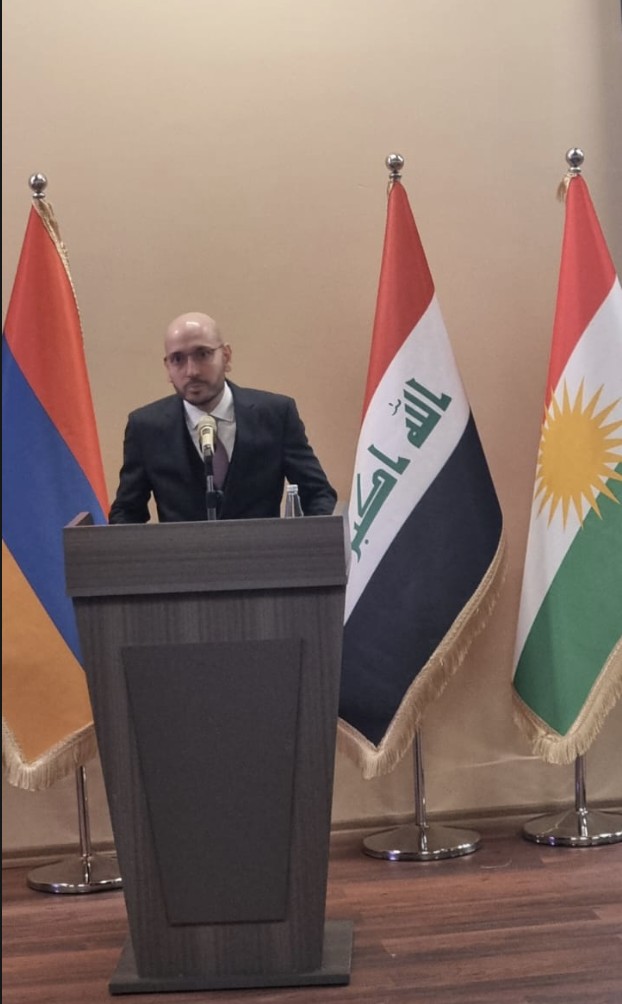
On Thursday, the first Armenian Armath Engineering Laboratory in the Kurdistan Region and second in the Middle East was opened in Ranya, with financial support from the UK-backed Raparin Regional Development Agency.
Armath Engineering Makerspaces’s educational programs introduce children aged 10–18 to engineering, robotics, and technology in order to provide them with skills for the future economy.
“It’s a really important day for our cooperation, especially in the field of education and engineering,” Armenia’s Ambassador to Iraq Ruben Soghoyan said at the opening of the event.
“It’s not just an institution for studying engineering. This is a place where we can create a young generation oriented to dream of their future and to make their region, their country, their future as they want to have it.”
Read More: Armenian Consulate Showcases Cultural Ties with Film Screening in Erbil
“It’s really important that we started from Ranya. We hope that this project will contribute to the development of Ranya and will expand to other regions to help build the future generation, which I’ve seen is smart, ambitious, and talented.”
Ambassador Soghoyan told Kurdistan Chronicle after the event that the project could initially be expanded to four areas in the Kurdistan Region, with further expansion to Baghdad and other parts of Iraq depending on its effectiveness and results.
“We cooperate and we discuss with the local governments so we’ll be following their needs and their suggestions for the location and scale of the project. We have it in the United States, India, Bangladesh, Kuwait, and Georgia, and now we’re launching it in Iraq,” he added.
Read More: Armenia and Kurdistan Region Celebrate Cultural and Historical Ties
“We are also thinking about bringing other companies, projects, and startups to explore [the region]. Armath is just the beginning and hopefully this success will attract other startups from Armenia to come and run their projects here.“
During the event, Kurdistan Regional Government (KRG) Deputy Prime Minister Qubad Talabani stated that a lot of development has happened in Duhok, Erbil, and Sulaymaniyah, but that the KRG wants to focus more on rural and regional development.
“Today we’re starting a new revolution, a technological revolution, an educational revolution, a revolution that is going to train new young talent from the rural areas of Kurdistan to become the next leaders in technology, in robotics, in AI, in matters that will be front and center to everyday life in the years ahead.”
Sedrak Vardanyan, Advisor to the Executive Director at Armath Engineering Makerspaces, underlined that “Armenia and the Kurdistan Region have many historical and cultural similarities, but we are united by one very important value: education, and particularly a love of learning,” he added.
“We hope the Armath workshop in Ranya will become an environment where children will not only learn to design programs and build robots, but also learn to work as a team and dream.
“This is not simply about opening a new technology workshop. Every child, regardless of where they live, should have the opportunity to become familiar with modern technologies,” he said.
He added that the curriculum includes basic programming, robotics, CNC laser and drilling machines, 3D modeling, 3D printing, and additional courses on advanced programming, electronics, and UAVs.
“Today, the Armat network comprises a total of 660 engineering labs,” he said. “Of these, 642 Armat and UAV labs operate in Armenia, while 18 are located in other countries, including France, the United States, Georgia, Kuwait, Bangladesh, and India.
“More than 10,000 children and young people have already completed the program.
“The Armath program is supported by the Union of Advanced Technology Enterprises, which represents Armenia’s high-tech sector and includes around 300 companies.
“Our goal is to develop a mindset that encourages children to learn independently, create, identify problems, and propose solutions. Through Armath, children are introduced to science and technology.”
A seasoned reporter and analyst who specializes in Kurdish affairs.