The Four Pillars of the Nation approach, articulated in the discourse of Jordan’s Prince Hassan bin Talal, offers a rigorous interpretive framework for understanding the formation of the Middle East’s civilizational sphere as the outcome of complementary historical roles rather than the product of competing or closed ethnic identities. The nation-state was not constructed upon a singular ethnic foundation; instead, it crystallized through the interaction of major communities that performed integrated functions in state-building, knowledge production, and the articulation of a shared normative order. Within this perspective, the “pillars” do not represent opposing collectivities but overlapping civilizational roles that together produced a flexible historical unity capable of accommodating divisions.
This article argues that the Kurdish experience in Jordan offers a contemporary embodiment of this framework. It demonstrates how civilizational plurality, when embedded within a stable civic structure, can reinforce rather than destabilize state-building and citizenship. The Jordanian case also provides a practical illustration of how identity, when situated within functional participation, becomes a source of cohesion rather than division.

The Four Pillars of the Nation
The concept of the Four Pillars of the Nation serves as an analytical framework for understanding the civilizational structure of the Mashriq region, which spans the Levant, the Arabian Peninsula, Anatolia, and the Iranian plateau. It moves beyond reductive ethnic categorization or closed identity paradigms. In his opening address to the Four Pillars of the Nation Conference held in Amman in 2018, Prince Hassan emphasized that Arabs, Persians, Turks, and Kurds constitute major historical components whose interaction generated a cumulative political, intellectual, and cultural sphere. This sphere did not arise from ethnic homogeneity, but from sustained interdependence.
Within this schema, each pillar performed a distinctive yet complementary function. The Arabs constitute the foundational civilizational pillar, as their early experience was linked to revelation, the formation of Arabic as a unifying language, and the articulation of a shared normative framework. Arabic fostered a common intellectual sphere and shaped early models of political and symbolic legitimacy, providing the nation with its overarching reference. The Persians formed the pillar of administration and intellectual production through governance traditions, bureaucratic development, and contributions to philosophy and science, strengthening state continuity. The Turks, meanwhile, emerged as the pillar of statehood and political and military authority, consolidating sultanic systems and sustaining the political order during periods of fragmented rule.
Within this civilizational framework, the Kurds can be understood as a pillar of balance and integration. Historically, they combined military and administrative leadership with social incorporation, and their identity developed in continuous interaction with state and society rather than in rupture from the broader civilizational order. Their geographic dispersion across key regions also positioned them between major political centers, fostering patterns of adaptation and participation rather than isolation.

The case of Jordan
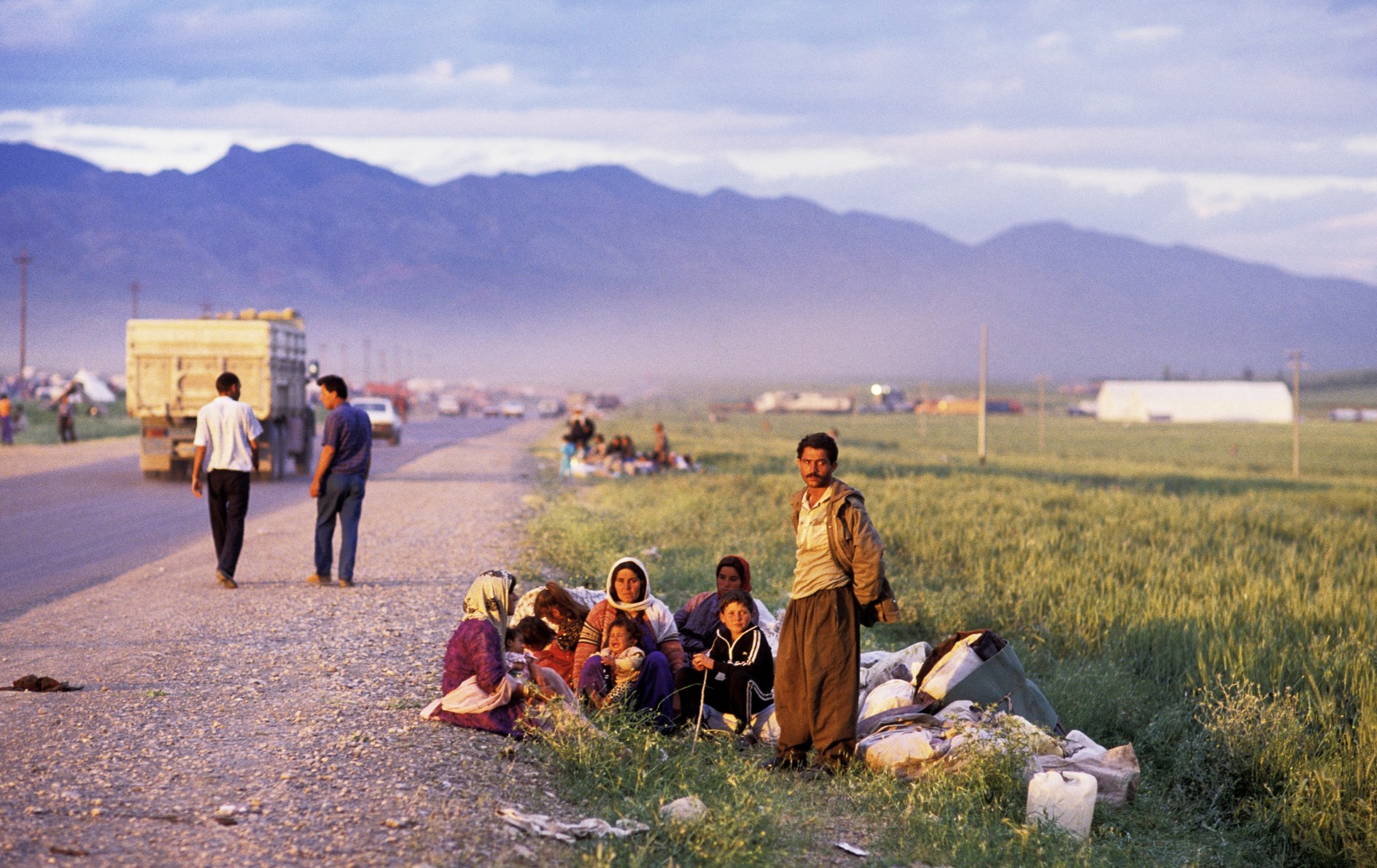
The rise of the modern nation-state redefined identity and statehood. In some contexts, Kurdish identity became politicized and positioned in oppositional terms; in others, it was integrated within civic citizenship. Jordan represents a notable example of the latter. The Kurdish presence in the country developed through gradual migration during the late Ottoman period and the early decades of state formation and was linked to military service, administrative roles, and economic activity. Rather than advancing separatist or confrontational agendas, Kurds integrated organically into society, avoiding ethnically based political conflict and contributing to a model of inclusion grounded in citizenship.
Integration in Jordan was neither abrupt nor imposed. At the social level, intermarriage, extended family ties, and daily interaction were central to transforming cultural difference into social cohesion. Intermarriage functioned not only as a familial bond but as a mechanism for expanding belonging and reinforcing a shared national identity capable of embracing diversity. Archival records from Sharia courts in cities such as As-Salt document Kurdish participation in property transactions, marriage contracts, and commercial life since the late Ottoman period, underscoring that integration was a long-term historical process rather than a recent development.
Culturally, Kurds maintained elements of private heritage such as songs, cuisine, and family memory without conflicting with national identity. Their presence emerged not as a parallel culture but as part of a broader national diversity that enriched the country’s heritage and reinforced social cohesion, reflecting the inclusive character of the Jordanian model.

At the political and institutional level, the Kurdish role in Jordan has been marked by a functional orientation grounded in participation within state institutions, commitment to the national framework, and prioritization of citizenship over narrow identity discourse. Kurds contributed to public life without seeking ethnic-based political representation, enabling the development of a balanced dual identity in which cultural particularity remains social, with national belonging serving as the primary political reference.
From the perspective of the Pillars of the Nation framework, this distinction reflects a shift from identity as differentiation to role as integration. Identity, when politicized as an exclusive claim, risks generating fragmentation; role situates identity within a civic function that contributes to institutional continuity. When communities embed their distinctiveness within shared state structures – through service, participation, and loyalty to constitutional order – plurality becomes an asset rather than a liability.
The Jordanian case, in this regard, provides a contemporary empirical expression of this principle. It demonstrates that equilibrium between role and identity is attainable, provided there exists a stable political framework, a deeply rooted culture of citizenship, the absence of exclusionary policies, and a unifying national reference capable of accommodating divisions.
This experience does not negate the complexities faced elsewhere in the region. In other national contexts, Kurdish identity has evolved under markedly different political pressures, including centralization, securitization, and contested sovereignty. Such variations underscore that integration is not automatic; it depends on institutional design, political culture, and historical trajectories. Jordan’s experience is therefore not presented as a universal template, but as a case worthy of analytical reflection.

A model of civilizational success
The concept of the Four Pillars of the Nation, as manifested in the Jordanian case, does not invoke the past as nostalgia. Rather, it offers an interpretive instrument for rethinking the relationship between plurality and statehood in the present. By framing communities in terms of functional complementarity within a shared political-ethical order, it provides a vocabulary for reconstructing cohesion in societies marked by identity tensions.
Within this broader reflection, the Kurds of Jordan represent a model of civilizational integration grounded in the balance between cultural particularity and national belonging. Their historical experience did not translate into separatist mobilization but into institutional participation. They contributed to the economy, education, public service, and the consolidation of state institutions while maintaining a culturally distinct yet institutionally integrated presence within the national fabric.
This model suggests that successful integration is achieved neither through erasure nor through isolation, but through conscious engagement within the framework of citizenship that assigns a constructive civic function. When plurality is anchored in participation and shared responsibility, it reinforces stability and strengthens the state’s capacity to endure.
is a Jordanian professor, researcher, and international consultant. Currently, she is working as Assistant Secretary-General, Arab Thought Forum- for Studies, Research, and Development.