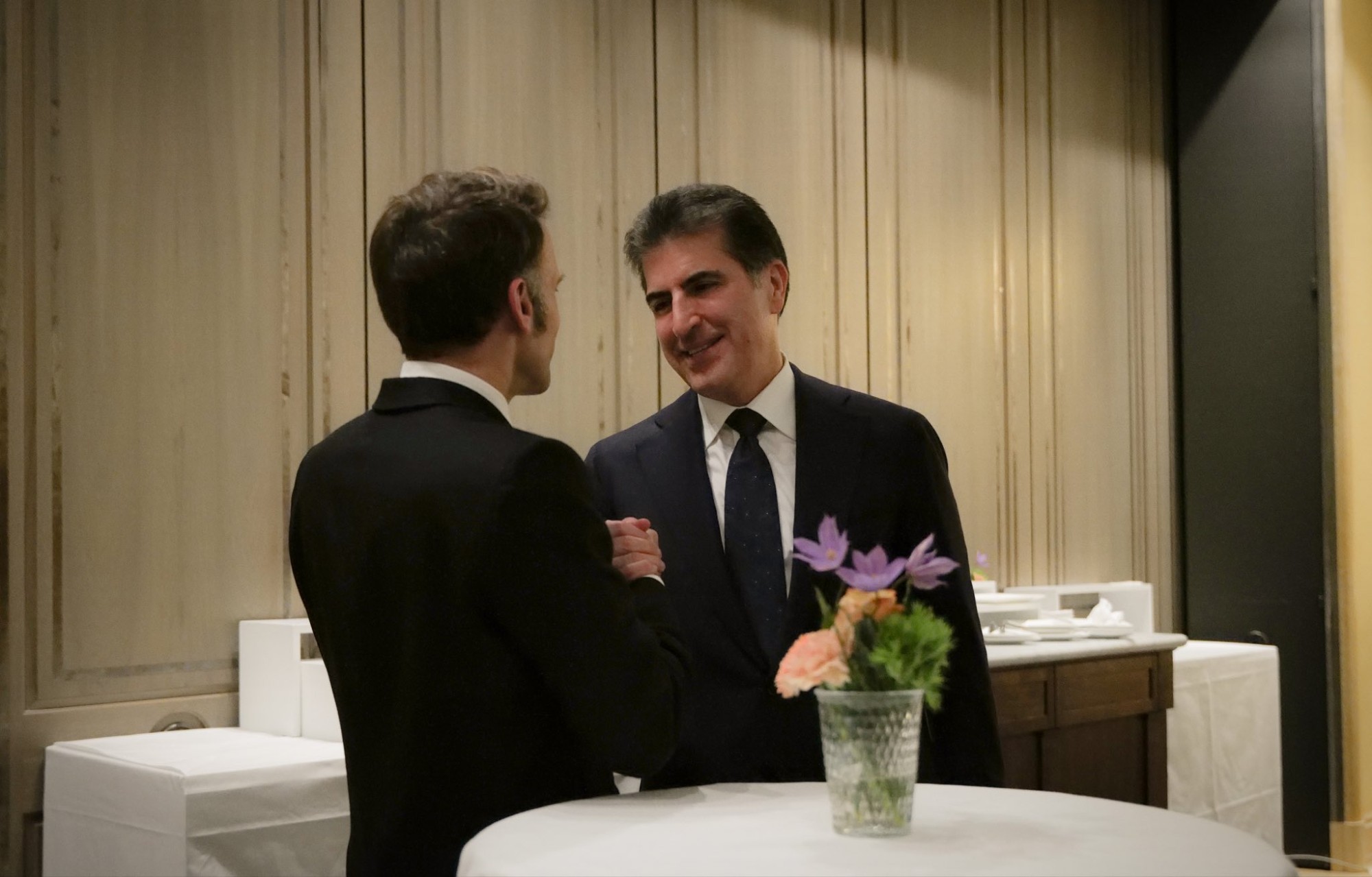
At the 62nd Munich Security Conference (MSC) on Friday, Kurdistan Region President Nechirvan Barzani met with several top leaders from the Middle East and Europe, including France’s President Emmanuel Macron, who he thanked “for his steadfast support and for being an ally in promoting peace and stability.”
On the sidelines of the MSC, Barzani also met with Germany’s Minister of Defense Boris Pistorius, during which the Kurdish leader expressed gratitude to German military forces for their continued mission in Iraq and the Kurdistan Region, acknowledging the active involvement of German advisers in training the Peshmerga and facilitating the reform process within the Ministry of Peshmerga Affairs.
Read More: Kurdistan Welcomes Germany’s Decision to Extend Army Mission
In January, Germany’s parliament extended its military mission in Iraq until the end of January 2027.
Minister Pistorius also reaffirmed his country’s commitment to supporting Iraq and the Kurdistan Region as allies and friends, highlighting the importance of upholding peace and stability while fostering continued collaboration to combat terrorism.
Additionally, Barzani met with Germany’s Minister for Economic Cooperation and Development Reem Alabali Radovan to discuss German initiatives and assistance in Iraq and the Kurdistan Region, particularly in reconstruction, human development, and reform support.
Barzani conveyed the Kurdistan Region’s gratitude for Germany’s assistance to refugees and for strengthening service infrastructure, with special thanks for the support extended to the Yezidi community.
Barzani also met with Italy’s Minister of Defense Guido Crosetto, in which they focused on strengthening Italy’s relations with Iraq and the Kurdistan Region, as well as enhancing security and military cooperation.
Barzani expressed appreciation for Italy’s support and its active role in the international coalition training the Peshmerga forces. Italy has around 400 soldiers active in the Kurdistan Region.
In response, Minister Crosetto reaffirmed his country’s commitment to supporting Iraq and the Kurdistan Region, commending the Peshmerga’s efforts in combating terrorism.
Barzani also met with UK National Security Advisor Jonathan Powell, where they focused on the most recent security and political developments in Iraq and the surrounding region, as well as the ongoing threat of terrorism.
He also met with several Middle Eastern leaders, including Sheikh Mohammed bin Abdulrahman al-Thani, Qatar’s Prime Minister and Minister of Foreign Affairs, where they discussed recent political and security developments in the region, as well as the implications of the ongoing conflict.
“We stressed the importance of principled and responsible dialogue and approach to address regional challenges in pursuit of lasting peace,” Barzani posted on X.
Barzani also met with Lebanon’s Prime Minister Nawaf Salam, during which they focused on ties between Iraq and the Kurdistan Region with Lebanon, as well as the latest developments in the political and security landscape in the region.
According to Lebanon’s Presidency of the Council of Ministers, both sides agreed on the necessity of sparing the region from any war that could burden it and emphasized the importance of consolidating stability throughout the entire region.
Additionally, Barzani met with Azerbaijan’s President Ilham Aliyev, where they discussed relations between Azerbaijan and Iraq, as well as the Kurdistan Region, exploring avenues to strengthen bilateral cooperation across various sectors.
The meeting also addressed the establishment of Azerbaijan’s Consulate in the Kurdistan Region and included an exchange of views on the political landscape in the region and other matters of mutual concern.
A seasoned reporter and analyst who specializes in Kurdish affairs.