How an Australian aid worker ran the route many fled into Kurdistan in 2014 – and why the miles mattered.
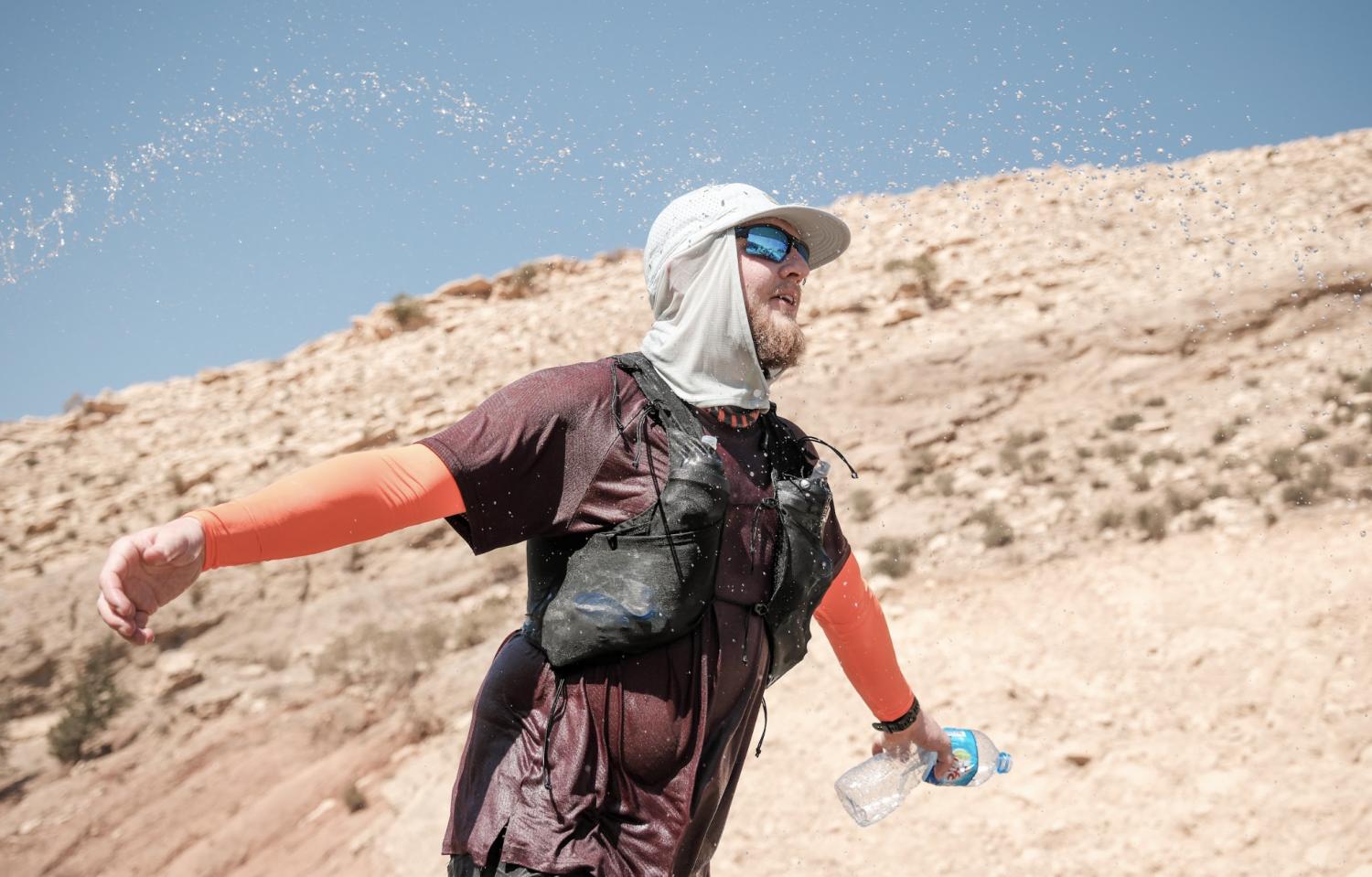
At the Kalak crossing from Nineveh into the Erbil Governorate, just after dawn, the Great Zab river was dark and still. Trucks crowded the road. A few stray dogs padded by. Three runners stepped onto the hot asphalt. By kilometer 30, Australian former aid worker Tim Buxton was bent over the gravel, exhausted. A paramedic stood by. The ambulance door was open.
“I was done,” he said later. “If I went to the hospital, I’d miss the meeting – and I wouldn’t have finished what I had come back to do.” He rinsed his mouth, took water, and moved off again.
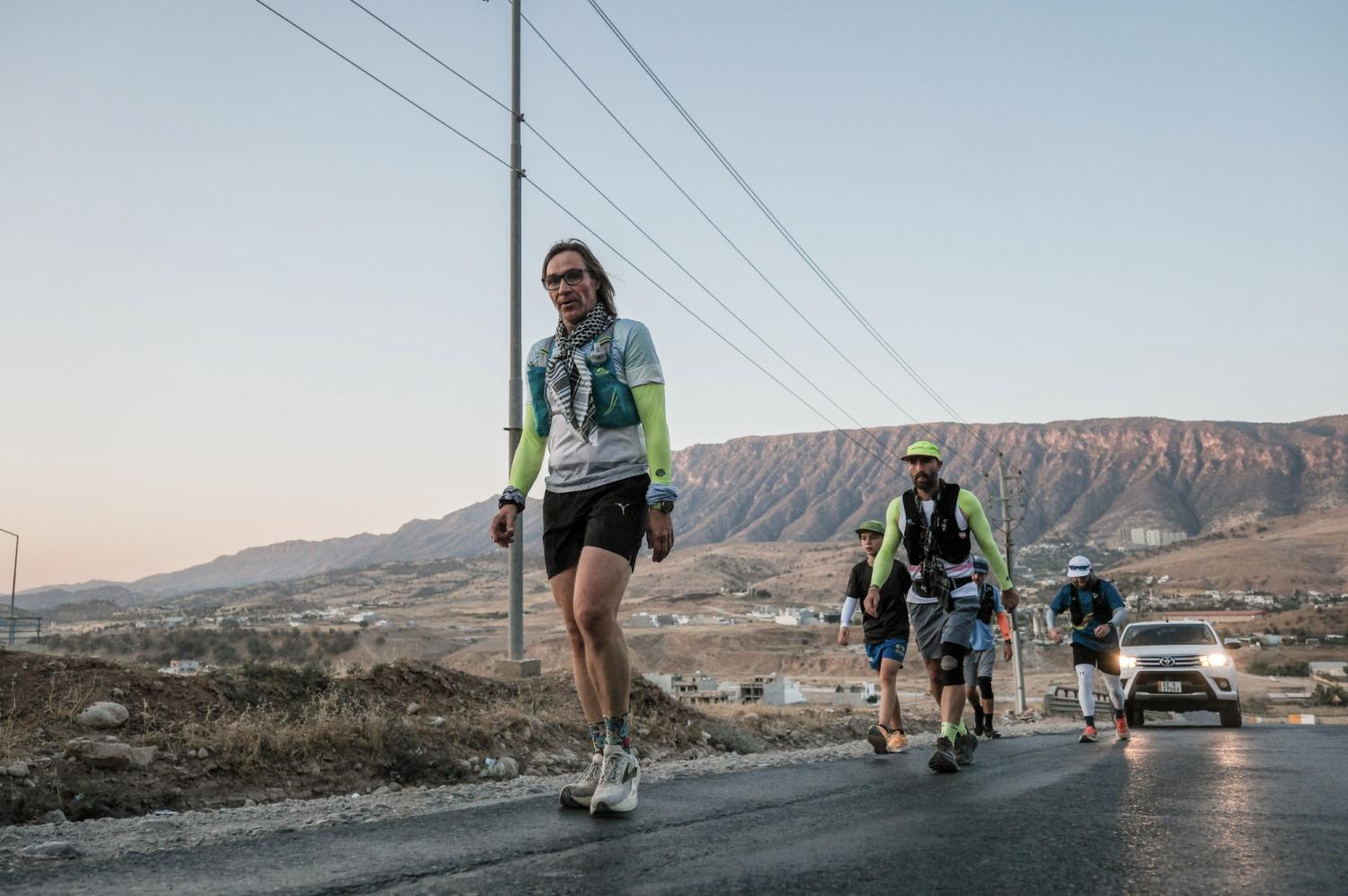
Over four days last September, Buxton and two teammates planned to cover about 160 kilometers: Kalak to Erbil, then Shaqlawa and Khalifan, through the Rawanduz Canyon and down into Soran – the route many families traveled in 2014 when ISIS tore across Nineveh. Midday temperatures hovered around 42°C. The team was small: Buxton; his coach, ultrarunner Mario; and Callum, a fellow ultrarunner from Melbourne. An ambulance idled behind them. Buxton’s 12-year-old son, Charlie, crewed from the back of a pickup truck and on foot for roughly 15 kilometers a day, passing ice and water.
Running in the shoes of refugees
The run was both a tribute to families whose first step into the unknown was an act of protection, and a statement that choosing to suffer a little might get people to look again at those who didn’t have a choice. “Refugees aren’t people to be pitied,” Buxton told Kurdistan Chronicle magazine. “They’re some of the most courageous humans I’ve ever met.”
His ties to the region go back to the summer when Nineveh and parts of Syria fell to ISIS. In June 2014 he and his wife landed in Erbil with three kids: a nine-week-old, a one-year-old, and a two-year-old. They settled in Soran to work with the U.S. nongovernmental organization (NGO) World Orphans and helped launch the Refuge Initiative with local officials – providing housing for displaced families, a school, and a clinic – and they lived among the families they served.
According to the Kurdistan Regional Government (KRG), about one million Iraqis fled into the Kurdistan Region during 2014 as ISIS advanced across Nineveh and nearby governorates. Years later, as some families returned to Mosul or Sinjar and others moved abroad, the Buxtons resettled in Australia, where Tim Buxton founded You Belong, a nonprofit dedicated to helping refugees integrate into Australian communities. What stayed with him was the gap between how refugees are debated in Australia and how they actually live. “People say, ‘walk a mile in someone’s shoes,’” he said. “I wanted to run a hundred.”
Countering narratives of displacement as a stain
He’d hoped to start near Bartella, east of Mosul, but permission never came. So he met an old friend at Kalak on the eve of the attempt and, with a police escort, pushed out at first light. Traffic thickened. Dogs gave chase. Day One almost ended under an overpass when dehydration slid toward heat illness. In the shade of the ambulance, he thought of a Yezidi boy he’d met years earlier – 14 at the time – who crossed into Turkey, failed twice to reach Greece, succeeded the third time, and eventually found safety in the Netherlands. That young man was flying into Erbil that afternoon. Buxton had promised to meet him.
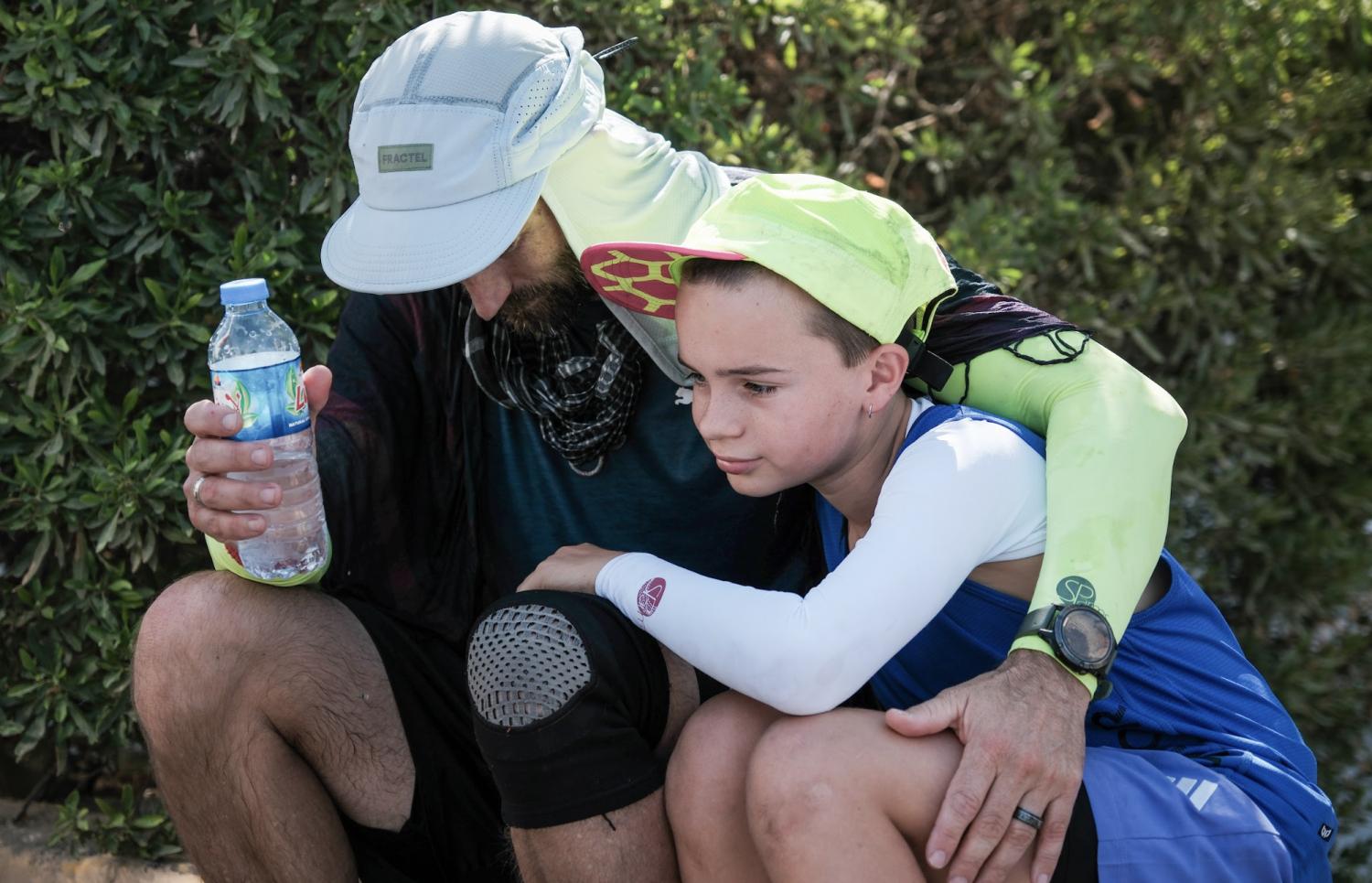
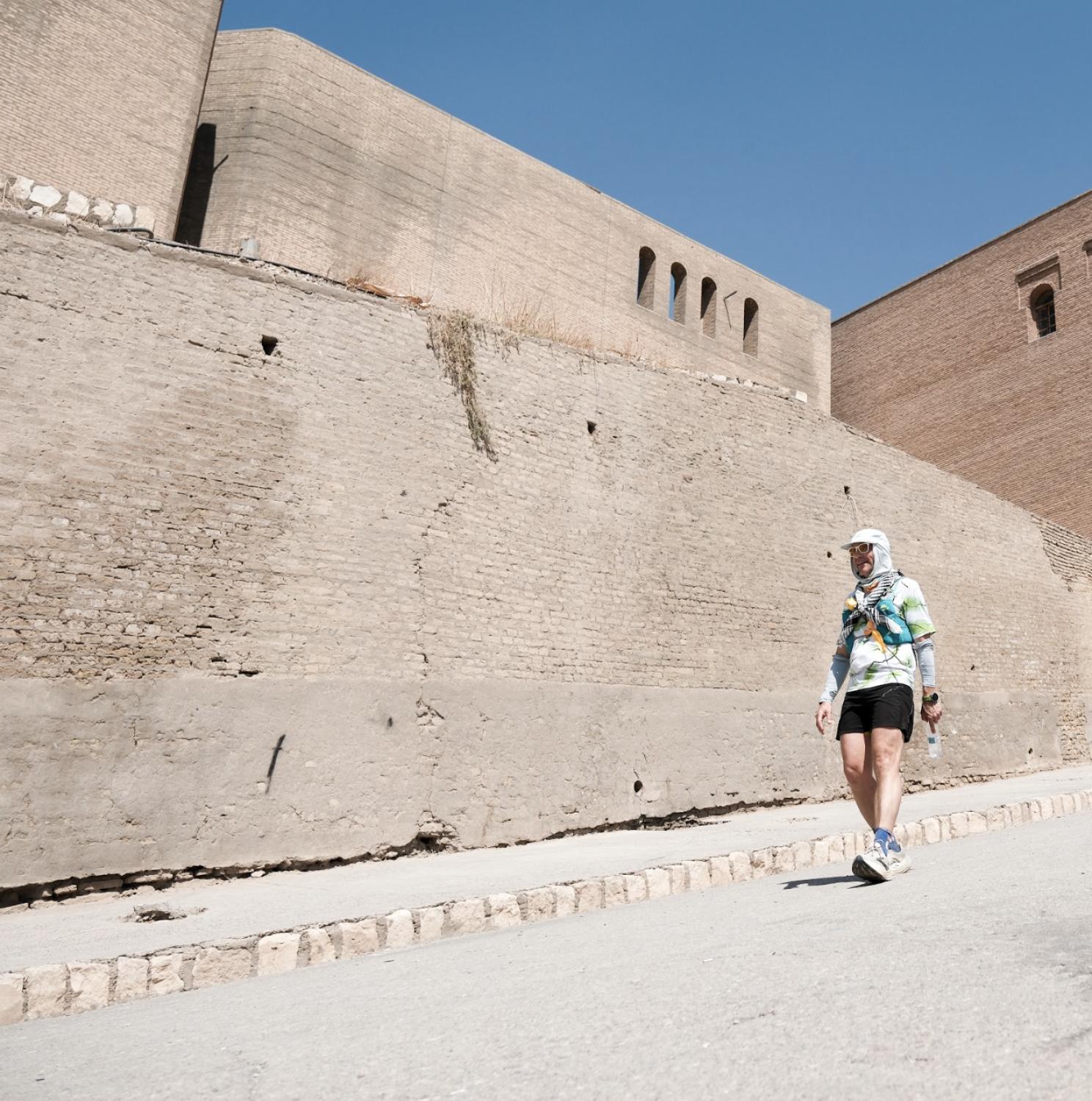
“That snapped something into place for him,” he said. Mario scrapped the original plan. They switched to run-walk intervals, strict five-kilometer ice stops, no bravado. The medics watched his color. He shuffled back onto the road, reached Sami Abdul Rahman Park in downtown Erbil and, cramping badly, took Charlie’s hand for the final jog to the Erbil Citadel. He finished Stage One in five hours and fifty minutes.
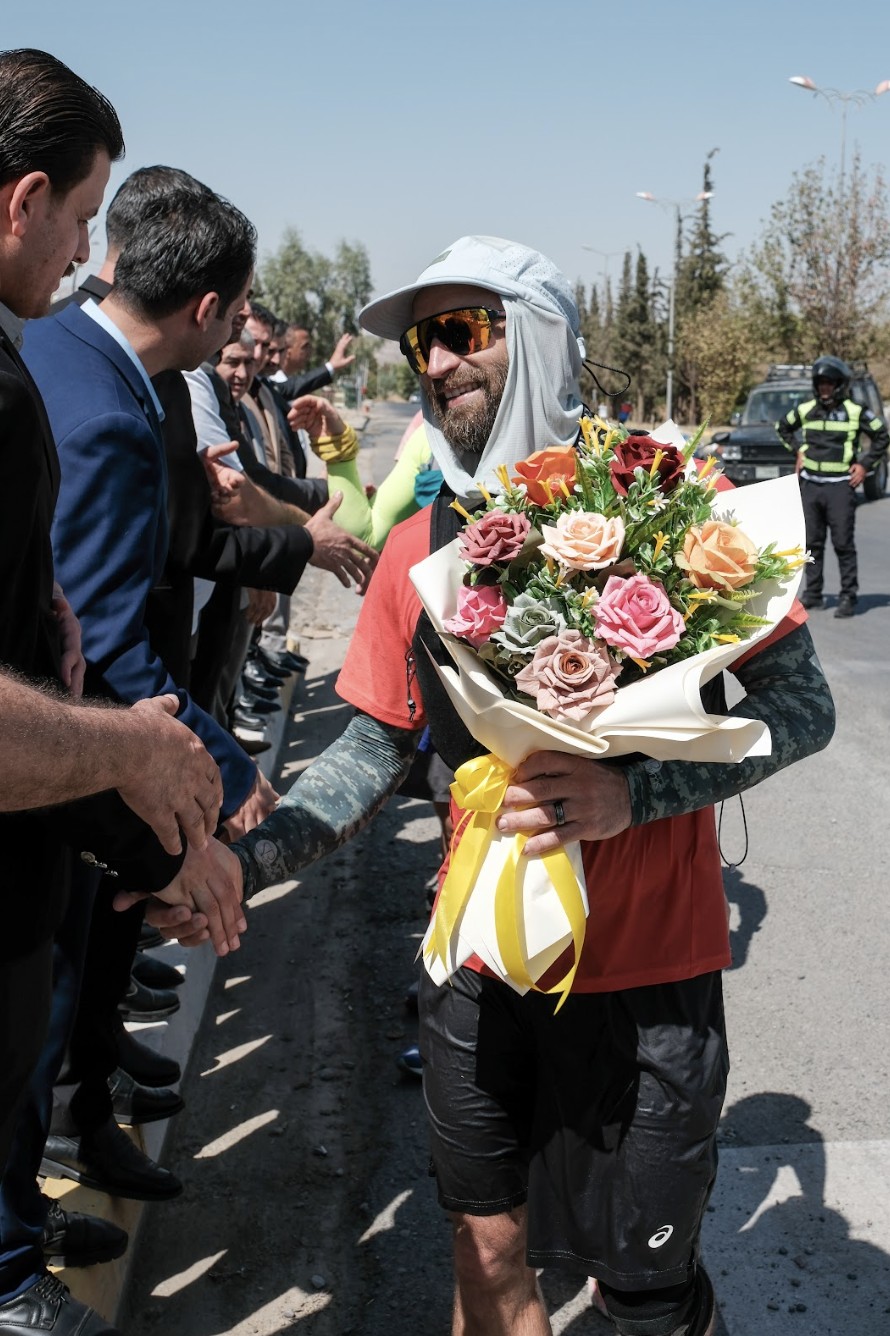
Day Two ran more quickly. Ice at the neck. Ice down the vest. Ice every five kilometers because it melted almost immediately. The heat was worse than Day One, but they found a rhythm and climbed into Shaqlawa with something like momentum. At the end of Day Two, local government leaders in Shaqlawa welcomed them, offering flowers, tea, and a brief reception. The runners posed for a photo – salt-streaked, sunburnt – and went back to work.
On Day Three they reached Khalifan, then stopped at Soran University’s athletics department to talk with students and staff.
Karwan Kakabra Kakamad – Assistant Professor and head of the Psychology Department at Soran University – put words to that idea. The marathon that traced the path many families took when ISIS advanced “was never just sport,” he said. For him, the point is to humanize internally displaced persons (IDPs) and refugees.
Kakamad worked alongside Buxton for years, offering psychological support and practical training to displaced families. He sees the run as a counter to narratives that treat displacement as a permanent stain. “An IDP doesn’t want to leave their country,” he said. “They want to stay in their own place.” In a time when some politicians urge governments to harden attitudes, Kakamad believes a visible act of solidarity sends a different message: “We sympathize with IDPs and refugees, and we know what they have been through.”
In town, Buxton visited old friends who had helped the Refuge Initiative when big international NGOs were thin on the ground. “Local leadership made everything possible,” he said. “We were the bridge.”
Day Four they ran through the Rawanduz Valley. The air cooled; the view opened. It was their fastest split. “We got stronger as we climbed,” Buxton said. By then the routine was simple and ruthless: every five kilometers, one minute to stop, apply ice, refuel, then keep moving.
Powered by Kurdish hospitality
Coming back after a few years, he felt the changes around Erbil were hard to miss: new towers along the ring road where building sites had once stalled; big houses rising. And the old pressures were still there – budget fights with Baghdad, salaries that slip. “What hadn’t changed,” he said, “was the reflex to make room. Assyrians, Chaldeans, Arabs, Kurds – people still looking out for one another.”
Hospitality trailed them the whole way. In Soran, old friends laid out a meal so generous it made energy gels seem silly. “You don’t run on packaged energy gels with Kurdish hospitality around,” Buxton joked. Dinner pulled in neighbors and then friends of friends. The talk moved from the day’s miles to the longer timeline such as Kurdish struggles, displacement, Peshmerga service, losses that began long before 2014 and have never entirely ended. The runners ate and listened.
Callum Sloan – 31, a coffee roaster from the hills outside Melbourne – had come to Iraq just weeks after meeting the team. He’d only just caught the “ultra bug” with a 50-kilometer race in the Blue Mountains. “I wanted running to mean something,” he said. “Not another medal. Something that changes how you live.”
He arrived expecting headlines and found layers. “Back home most people know ‘Saddam’ and ‘the Americans,’” he said. “You get here and there’s a living, welcoming place behind the headlines.” As soon as he returned to Australia, he was already asking when he could come back. “I miss the food. I miss sitting out on a warm night with people who were strangers an hour earlier. I came for a run and found a community. That’s the story I’m taking home.”
The journeys others never choose
A small film crew led by director Kitale Wilson came along to shoot a film, with a working title of The Return. The film intercuts the run with interviews – families who fled in 2014 and rebuilt lives in Mosul, Sinjar, and across Europe. The team is raising funds for postproduction and festival entries, hoping a streaming release might reach people who’ll click on “running across Iraq” and stay for the story behind it. “We’re not trying to trick anyone,” Buxton said. “Just show them what’s there.”
“If the documentary does anything,” Sloan added, “I hope it puts faces to the map – so when you hear ‘refugee,’ you think of the dad who served us tea, the kid who laughed at our terrible Kurdish, the grandmother who insisted we eat more.”
If it works, the idea could grow into an annual event: an ultramarathon designed with the KRG Ministry of Sport and local clubs, perhaps in spring when the hills are green and the rivers run. “Adventure tourism is growing,” Buxton said. “There’s room for this here.”
Kakamad hopes the race becomes a tradition – for reasons that go beyond charity to identity. “Hospitality is inherited – we shouldn’t lose it,” he said. Kurdistan’s welcome “without discrimination – religion, ethnicity, or culture” is something he believes should be taught to younger generations. The memory matters not as leverage – “not as a favor to hold over anyone’s head” – but as a record. Kurds themselves have known displacement and refuge. “Our own people went to Iran and were given a warm welcome,” he said. People still talk about it, but “maybe a young person – my own child – doesn’t know that.” An annual race would enshrine the lesson in public life – good for Kurds as a reminder of who they are, and good for others to see it.
Two images stuck with Buxton. One is a boy on a smuggler’s boat who grew up to become a doctor in the Netherlands and returned to Erbil to marry. The other is a father with both legs cramping, gripping his son’s hand and shuffling toward the Citadel because a promise matters – and because the journey he chose is nothing like the journeys others never chose.
“Empathy is the first mile,” he said. “Action is the rest of the race.”
A Kurdish journalist with 15 years of experience in media development in Iraq. He has contributed to both local and international media outlets.