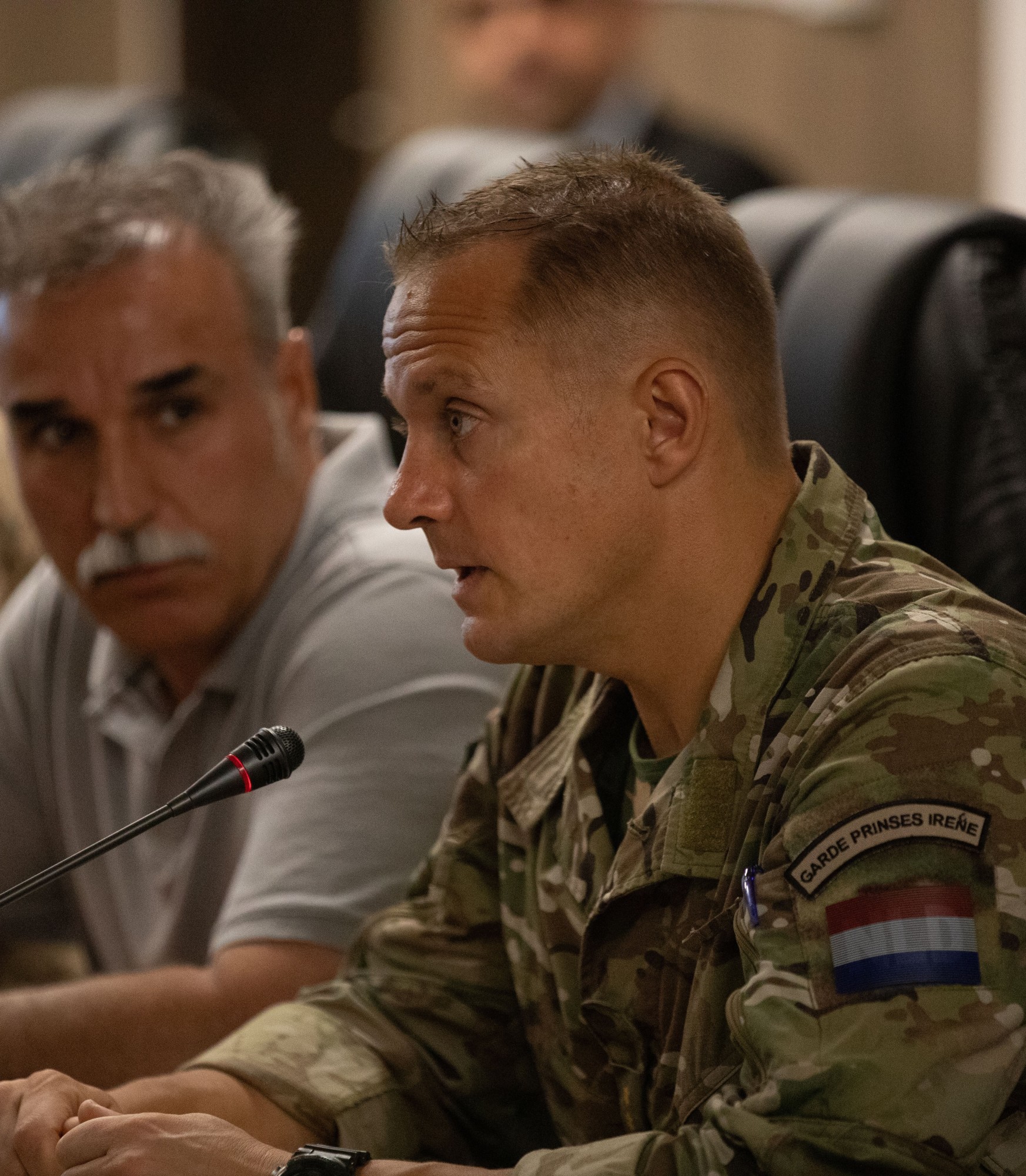
Colonel Niels Verhoef of the Royal Netherlands Army recently completed a six-month deployment in the Kurdistan Region, where he served as team leader of the Joint Operational Command Advisory Team–Netherlands under the anti-ISIS U.S.-led mission Operation Inherent Resolve (OIR). Verhoef has served in the Dutch army for more than 26 years, having previously been deployed to Afghanistan and to the UK. Speaking about his mission with Kurdistan Chronicle, Col. Verhoef said the Dutch role in Kurdistan today is almost entirely advisory, focused on supporting long-term reform of the Peshmerga forces rather than direct training.
Read More: Dutch Military Advisor: The Netherlands Benefits From a Stronger Peshmerga
Peshmerga reform
The Netherlands, Italy, France, Germany, the UK, and the United States are part of the Multinational Advisory Group, which supports the Peshmerga unification process. Peshmerga soldiers are split between political factions, with 70 units under the Patriotic Union of Kurdistan (PUK) and 80 units under the Kurdistan Democratic Party (KDP), but the goal is to bring all of these units under the umbrella of the Ministry of Peshmerga Affairs (MoPA) by 2026.
This is part of a renewed non-binding memorandum of understanding (MoU) signed by the U.S. Department of Defense and the MoPA in 2022.
The unification process “was originally supposed to be completed by September 2025, but the MoU was extended by one year, so the target is now September 2026,” Col. Verhoef said. “We help with the MoU that the Americans have with the Kurdistan Regional Government (KRG),” he said, which includes uniting units under MoPA authority.
“Within the context of Inherent Resolve, we provide advice at the operational level,” Col. Verhoef explained. “That level sits between the ministry and the divisions and brigades. These are the future Area Commands, which will form the backbone of the new force structure.
“Initially, 44 brigades were brought under the MoPA. But controlling 44 separate units directly is such a large task that it is neither effective nor efficient. So intermediate levels are needed, because otherwise the chain becomes too long,” he said.
Read More: Ministry of Peshmerga Aims to Increase Female Participation
“Above those brigades, divisions need to be created: one division for every four brigades, so in total 11 divisions. Above that, there will be two Area Commands.”
In the past, the Kurdish Peshmerga front line against ISIS was divided into eight operational sectors with its own commanders, which were split evenly between the KDP and PUK forces. “The goal is to replace these sector commanders with the division commanders,” Col. Verhoef added.
According to Col. Verhoef, an important challenge with respect to Peshmerga unification is building more trust, especially at the MoPA level. “But what I notice is that the lower you go in the organization, the less influence political issues have on daily operations.
"Improving political trust could speed up progress toward what would be militarily possible,” he added. “It is also important to avoid creating a hierarchical and centralized system that slows down decision-making.”
However, he mentioned that the Kurdistan Region has huge opportunities. “It is such a shame that political rivalry holds it back. If I could wish something for the Kurds, it would be greater unity. Almost no one around the region benefits from a successful Kurdistan – except the Kurds themselves.”
Nevertheless, he confirms that real reform takes generations. “We, as the Dutch armed forces, are still present in the former Yugoslavia. To carry out real reforms, my rule of thumb is that you need to stay for two generations to truly make a difference,” he said.
“Depending on how long you consider a generation to be, you can attach a certain number of years to that. So it is also a utopia to think that this can be arranged in two or three years.”
Dutch-Kurdish links
There are also very strong historical ties between Kurds and the Netherlands. There are reportedly 7,000 Dutch Kurds living in the Kurdistan Region, which makes the work easier for Dutch soldiers. “You even encounter Dutch-speaking Kurds within the Peshmerga – from junior ranks up to generals –because they fled to the Netherlands, or they have family who lived in the Netherlands, or they still know the Dutch from our actions when we were here with Operation Provide Comfort to help them out of the mountains [in the 1990s].
“So at almost every meeting we have, it’s like, ‘Oh, my brother lives in the Netherlands, let’s give him a quick call,’ or, ‘I lived in the Netherlands.’ So there’s already a kind of feeling that you’re not in some no-man’s land. This is a region that has strong ties to where we come from.”
Future of the Dutch mission
The Dutch military presence in the Kurdistan Region has shrunk dramatically over the years, and there are questions about whether it will remain after the mission of the U.S.-led coalition ends in September 2026 and transitions to a bilateral partnership.
At its peak, over 120 Dutch soldiers were deployed in the Kurdistan Region, including force protection units that left in 2023. In the past, the Dutch army also provided training to Peshmerga forces during the fight against ISIS. Today, only around ten Dutch advisory personnel remain in Erbil.
“That means we only provide advice and no longer conduct training ourselves. That is actually good for the region and for the Peshmerga, because, ultimately, they must be able to train, deploy, and sustain their own forces independently."
Furthermore, there is also the NATO Mission in Baghdad, where the Dutch have around 30 advisors.“There are actually two frameworks,” he said. “OIR is a U.S.-led anti-ISIS mission. As it stands; ISIS has been militarily defeated here. We have to stay alert, but currently the threat to overall security is minimal,” Col. Verhoef said.
As a result, OIR is expected to shift its focus away from the Kurdistan Region. However, individual countries will remain engaged through bilateral agreements with the KRG.
“Italy and Germany continue training under bilateral frameworks,” Verhoef said. “The British operate from their consulate, and the Americans will continue to do so as well.”
Read More: Dutch Defense Minister Sees Continued Need for Military in Iraq
“The [Dutch] House of Representatives has been informed that, for now, we have the intention to remain active in Iraq – and therefore also in the Kurdish region,” he added.
In any case, the Dutch consulate will remain in the Kurdistan Region, he said. “Those diplomatic ties will continue, and the economic ties with the region are also strong. The military ties are something we are currently reviewing.”
Hospitality
Col. Verhoef also mentioned that the hospitality of the Kurds is incredible. “It doesn’t matter where you go, whether you’re in uniform or in civilian clothes – you are welcomed everywhere and invited everywhere. For the Kurds, that hospitality is an incredible motivator for the mission.”
He also said the Dutch advisory detachment has also invested heavily in getting to know the culture and the history. “For example, we visited the Red Museum in Sulaymaniyah. We went to Halabja and laid a wreath there. We also went to Zakho, for instance. In this way, we try to better understand the culture and the history, and to know why we are here."
During his stay, Col. Verhoef said he did not feel unsafe in the Kurdistan Region for one moment. “It has enormous potential, especially in that sense. You can already see it over the course of six months: when you drive off the base, how the ring road used to look and how it looks now. You can see how apartment buildings are springing up everywhere.”
He said soldiers that don’t leave the Erbil air base have a very different image of the Kurdistan Region than those who go out frequently.
“Those people really think of a desert, war, trenches, and all sorts of things like that, whereas they don’t think about, say, sitting down to drink a cup of tea at the citadel.”Col. Verhoef also said he wouldn’t mind returning to the Kurdistan Region for a visit as a civilian.
“Honestly, I would feel comfortable coming here with my family. I would dare to take a holiday here. I’m not sure whether my four ladies back home would feel the same, as that probably has more to do with what there is to do here. But the rich history and the level of security are simply good.”
A seasoned reporter and analyst who specializes in Kurdish affairs.