On Sunday, Kurdistan Regional Government (KRG) Prime Minister Masrour Barzani thanked the international community for supporting Operation Provide Comfort, which led to the establishment of a no-fly zone over the Kurdistan Region in 1991.
“Thirty-five years after UNSC Resolution 688, the people of Kurdistan still remember the international support that came at a time when genocide, displacement, and oppression threatened our survival,” Prime Minister Barzani posted on X.
“That support helped save lives, open the way for humanitarian relief, and lay the foundation for the Kurdistan Region as it stands today. We will never forget the sacrifices of the past and the support of our friends.”
After the uprising by the Kurdish people in March 1991, over one million Kurds fled to the Turkish and Iranian border after the Iraqi Ba’ath regime retaliated.
Danielle Mitterrand, the wife of France’s then-President Francois Mitterrand, played a key role in campaigning for a no-fly zone in the Kurdistan Region. As a result, there are two schools named after her in the Kurdistan Region.
The UK government under John Major also played an important role in proposing the creation of a safe haven in Kurdistan. In 2021, the KRG renamed a street in Erbil after the former UK prime minister.
The United States, UK, and France launched Operation Provide Comfort in April 1991 to establish and enforce a no-fly zone over northern Iraq, following UN Security Council Resolution 688 – adopted on April 5, 1991 after lobbying by the three countries – which ultimately led to the establishment of the Kurdistan Region and its first elections in 1992.
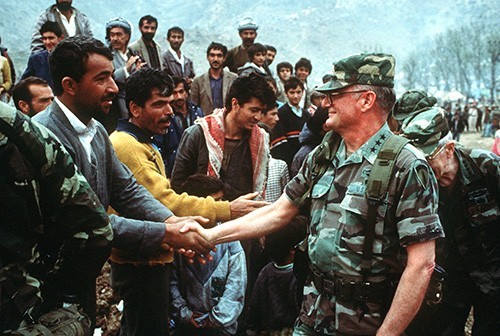
Operation Provide Comfort included a multinational military force of 25.000 military personnel led by U.S. Lieutenant General John Shalikashvili.
“The countries that supported the resolution were the United States, Britain, the Soviet Union, France, Austria, Belgium, Ecuador, Romania, Congo, and Cote d’Ivoire. Yemen, Cuba, and Zimbabwe voted against it, while China and India abstained,” the Kurdistan Democratic Party (KDP) Foreign Relations Office said in a post on X.
“Although the resolution did not explicitly call for the establishment of a no-fly zone or safe haven, Prime Minister John Major played a key role in persuading President George H. W. Bush that the United States, France, and Britain should jointly establish a no-fly zone north of the 36th parallel. This protected area later came to encompass much of Kurdistan. It was enforced from the Incirlik Air Base in Turkey and remained in place until 2003.”
Operation Provide Comfort continued until the end of December 1996. It was then renamed Operation Northern Watch. France subsequently withdrew from the mission, and responsibility for protecting the area fell to the United States and the UK.
“That aerial umbrella made it possible for Kurdistan, just over a year later, to hold elections on 19 May 1992 and to form its first cabinet on 4 July of the same year. In this way, the Kurdistan Region emerged as a de facto entity. With the adoption of Iraq’s 2005 Constitution, it was formally recognized as a constitutional region within the federal state of Iraq,” the KDP said.
“On this occasion, we extend our heartfelt gratitude and deep appreciation to all the countries and personnels that played a part in protecting Kurdistan and its people during those profoundly difficult and calamitous times.”
A seasoned reporter and analyst who specializes in Kurdish affairs.